Friday, April 30, 2010

Tour though Turkey

It turns out we both really like Turkish food. We split most of our meals so we could also try the soups and salads. The first picture is a woman making a “pancake” which is a very thin type of crepe (not as eggy) filled with whatever…we had cheese and spinach. The stick in her lap is her rolling pin; she’s looking at one cooking on the grill, and preparing another one. We found that they were always made in a restaurant but open to the street so people could buy them and eat them on the run.


The next picture is of a very typical method of cooking. They cook a variety of food from veggies to all kinds of meats and stews in clay dishes. The food doesn’t burn to the dish, but come out piping hot. The second picture is the same thing with a twist. The bread is used to seal the top to the bottom and the bottom is more the shape of a soup bowl. Jan drank apple tea (hot apple juice) while Chuck chose the more traditional Turkish coffee (with little or no sugar!) Many of the shops we entered offered us one of the drinks and they were brought by someone like the guy in the 3rd picture.


Every minute of the trip was something new either culturally or geographically. We are going to pick and choose, or it’ll take you two weeks to read what we did. On our way to the region of Cappadocia (we stayed in the town of Goreme) we stopped at the second largest lake in Turkey, Salt Lake. The pictures are of Chuck and our friends Kath and her mom, Nina standing on a walk and a rock covered with salt. Notice all of the white to Chuck's right and behind them.


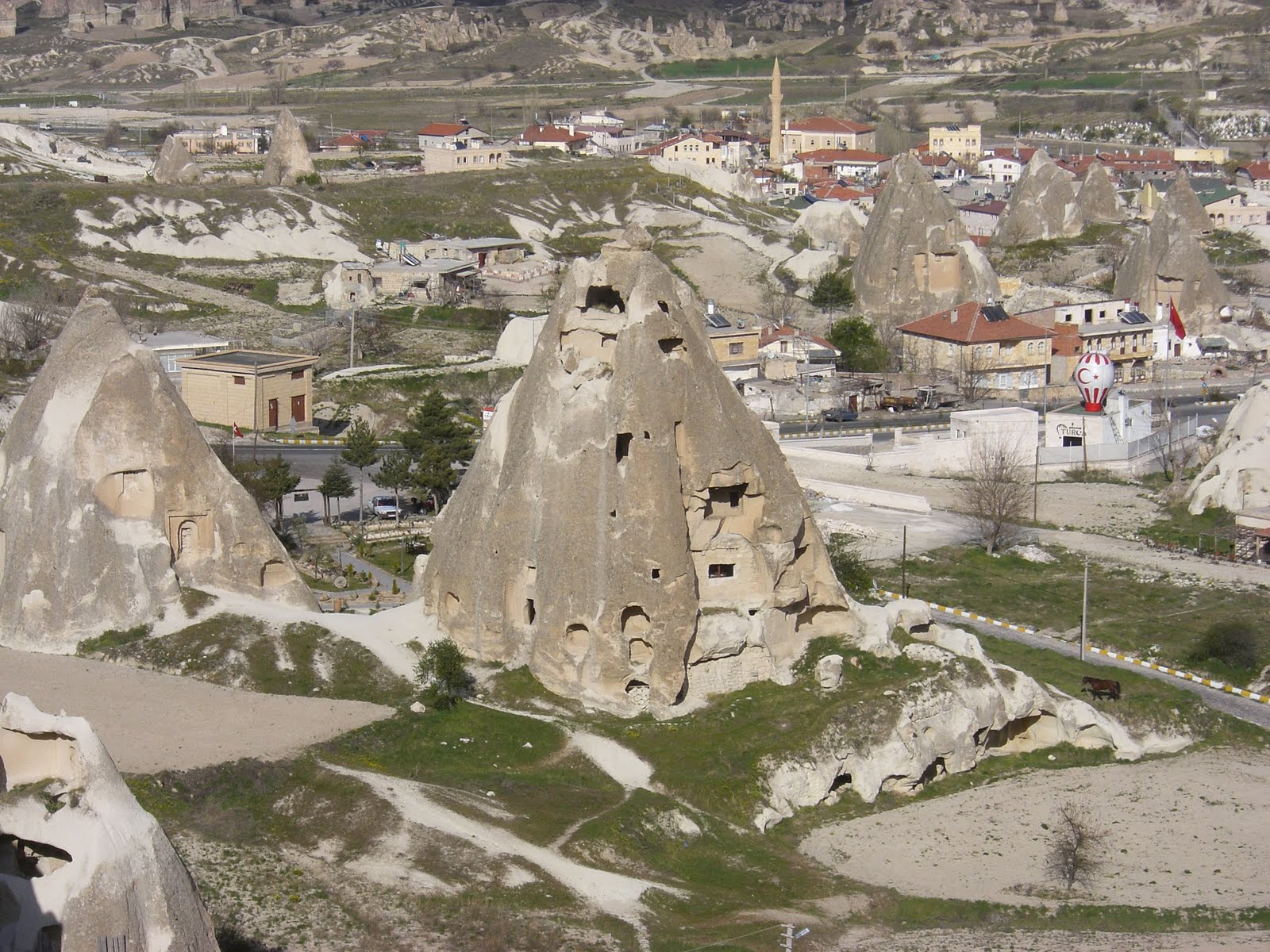
The area of Cappadocia was all under water millions of years ago. According to our guide, the rock is very soft until it’s exposed to oxygen. Over time, the water cut into the rock, leaving lots of unusual rock formations. Then, people began carving them to make caves and homes. Here are a few of the rock homes. Some pictures were taken from the hot air balloon ride that we took over the area (which was absolutely fantastic!) The second picture in this series is of the rock formation when it had a hard rock layer on top. They lovingly call these fairy chimneys. The last picture is of (left to right) Nina, Jan, Stacey, Kath and Chuck…to prove we actually went for a balloon ride. You can even see the rock formations in the background.



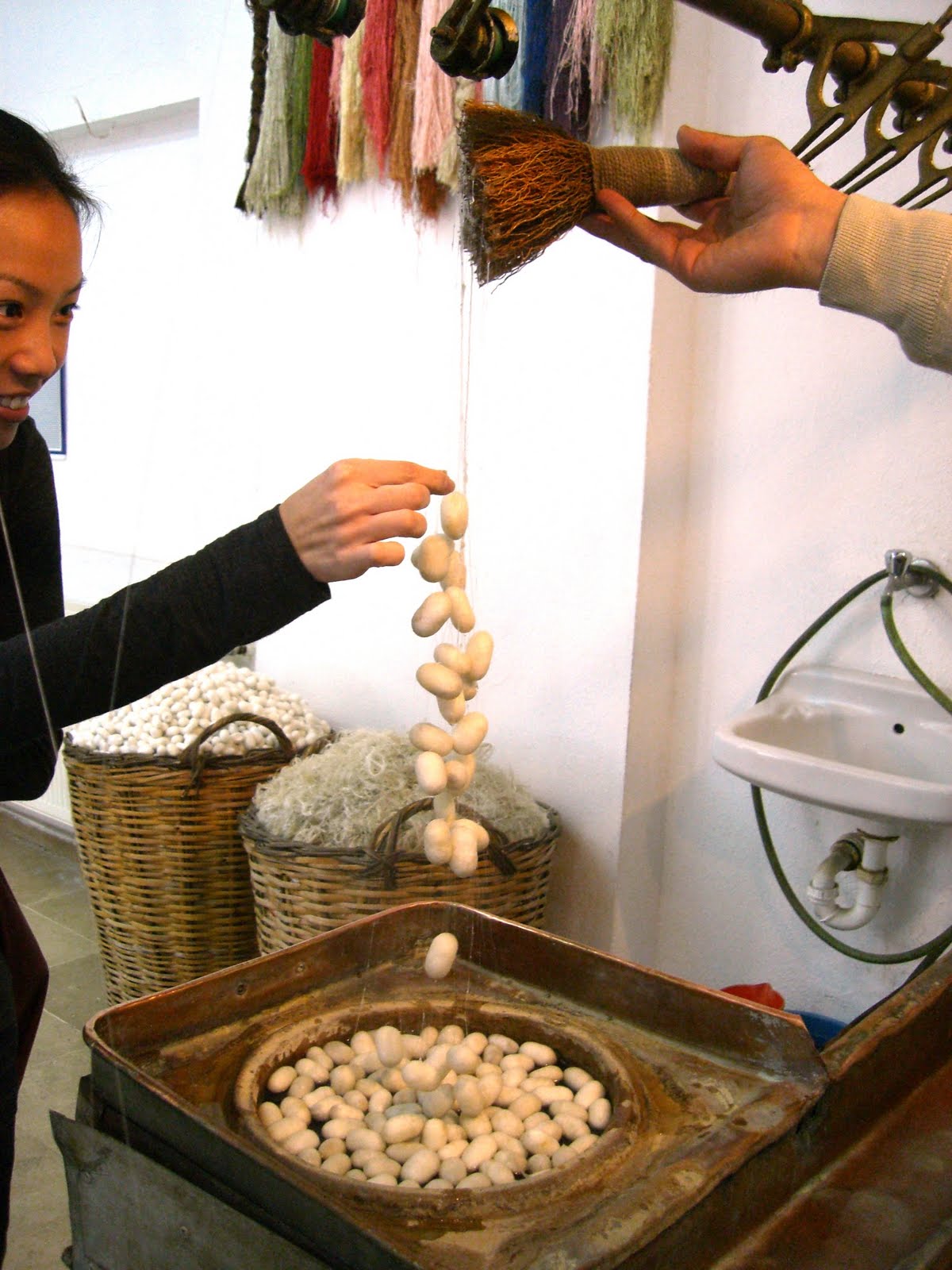
We learned how silk comes from the silk worm to silk material including how the silk is “farmed”, gathered, spun etc. The next picture is of the cocoons. They are boiled to kill the silk worm inside, and then unwound. In the picture, the man took a brush and picked up several by the silk threads (which Yuli is touching). It was fascinating.


We visited Derinkuyu, an underground city built around 700 BCE. It was used to hide from invaders. There were rooms for food storage, kitchens, churches, stables, churches, wine presses and ventilation throughout. The whole thing was quite remarkable. The stables were in lower levels than the people so the ventilation wouldn’t bring the smell through the rest of the rooms. The picture is of Jan and Yuli coming through a tunnel. There is a large stone off to the left that would have been used to seal off the tunnel in case they were invaded. Many of the upper tunnels had the rock gates that could only be opened by the lower side, trapping the invaders.


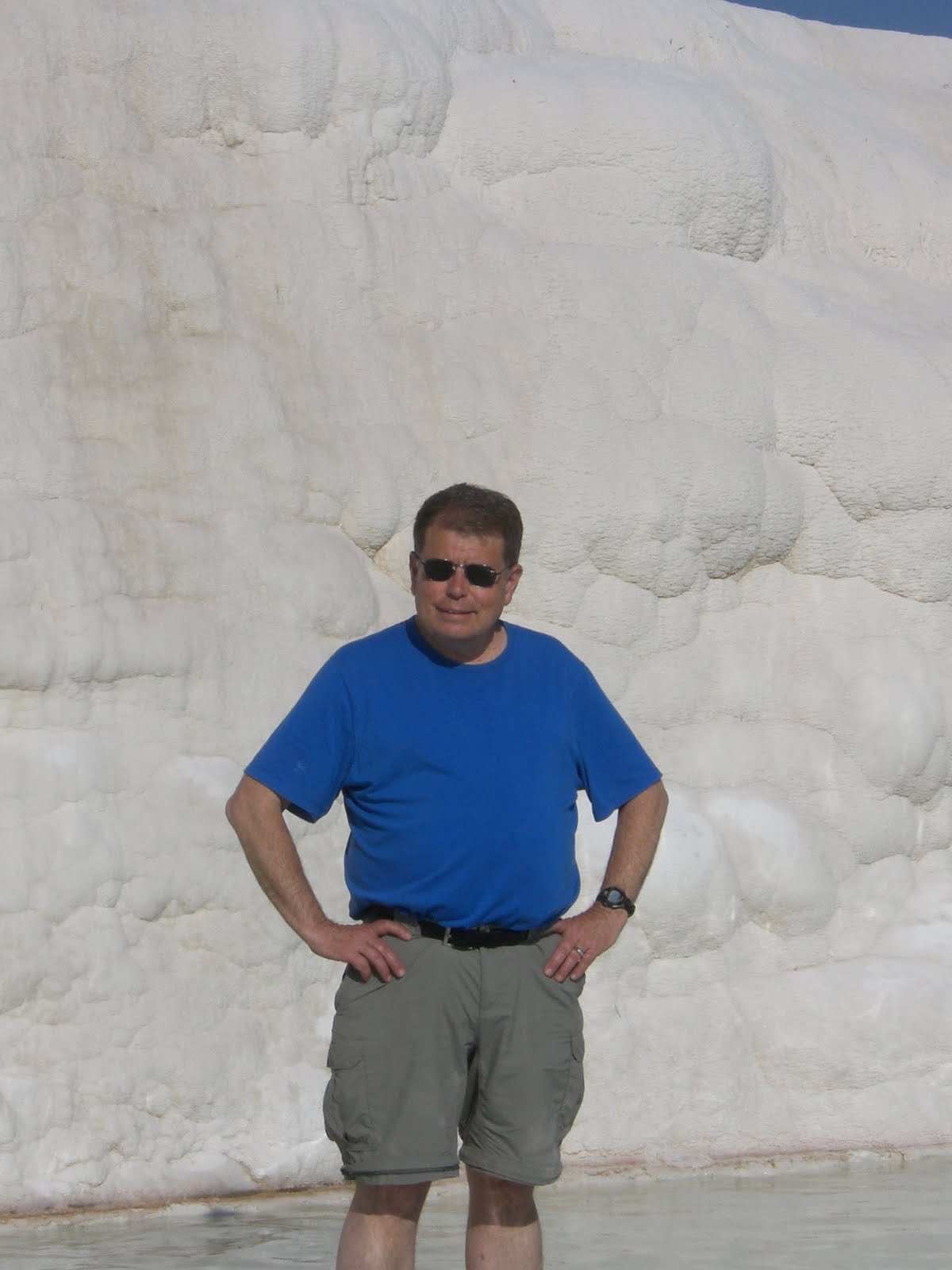
Our next stop was the hot springs of Pamukkale, which weren’t hot but they were very interesting. The water has calcium carbonate in it, which settles, turns into jelly and then eventually hardens on the rocks. It’s quite beautiful. Chuck found tad poles in the one of the pools. You can see one in the middle picture.



Turkey has snow covered mountains, lots of beaches on the Mediterranean, arid and rain forest climates and lots of ruins in pretty good shape. We went to Ephesus and there were great ruins. But the thing we’ve never seen before was the public bath. It was only for men, had constant running water beneath the seats and had many places for incense and perfume underneath too. We’re sure this is not what Ephesus is known for but we were impressed. The picture is of several members of our group. The next two pictures are from our dinner the last night.


Random thoughts about this impressive country: The country has been occupied by many. But in 1923, it became a state and education became the goal of the country. They have a 96% literacy rate. The country is VERY clean, even the public bathrooms. When our bus stopped for breaks, someone at the gas station washed the buses. Parts of the country were dusty but cars, trucks and buses were spotless. The roads and sidewalks were in good shape. The people were very warm and friendly. Even the people trying to get you to come into their shops help you out.

Monday, April 26, 2010

Istanbul

We went to Turkey on a G.A.P. tour but got there early to see more of Istanbul. We arrived in the beginning of tulip season and when we returned two weeks later, they were still beautifully in bloom. The city is big (14 million people), bustling, has beautiful buildings (in a different way than Paris and Prague.) There were people everywhere we went and always very nice. We’ve found most of the European cities we’ve visited, including Cluj, Romania, are much more densely populated than we are used to in the United States.

We ate breakfasts of a round bagel like bread with sesame seeds, and fresh pomegranate juice (delicious!) We snacked on a sticky ice cream served by an entertaining man who stole a customer’s cone out of his hand with the whole glob of vanilla ice cream.


We saw Haghia Sofya, a church turned mosque—Turkey is 96% Muslim but is a secular country. The rural or older women wear scarves, but you see VERY few face and body coverings— It is huge…large enough to put Notre Dame inside of it. When a church, it had beautiful mosaics and paintings on every inch. As a Mosque, the faces had to be removed or covered, and they added the large wooden discs with writing on them. To give you a bit of the scale, the second picture is standing on the bottom floor. The third picture is workers renovating one of the wooden discs that you can see in the second picture.


We went to the Basilica Cistern, also incredibly large…and wet. It is larger than two football fields. It was built in the 6th century CE and has 336 columns.


We met fellow tour goers, Nina and her grown daughter, Kath a day before the tour and saw Topkapi Palace and the Grand Bazaar. Both were wonderlands. The palace and its grounds were beautiful, as shown in the picture below of Kath in the flower garden. Besides the splendor, we saw land deeds (2nd picture) and many relics (Chuck was delighted) like Joseph’s turban, Moses’ staff, Abraham’s pot, St. John’s arm, Mohamed’s beard.


We were listening to a concert on a small outdoor stage when this guy on his motor cycle drove up to listen. Jan took these pictures as he was driving away.


We saw the Blue Mosque, the only Mosque in the world with 6 minarets. The Mosque in Mecca had 6, but when Sultan Ahmet I commissioned the Blue Mosque and recognized the problem, he paid to have a 7th minaret added to the Mosque in Mecca. The other picture is of a Muslim man washing his feet, lower legs, arms, hands and face before he goes into the mosque to pray. The faucets and benches were on the side of the mosque.


This is a brief description of our time in Istanbul.  We will write about the rest of our Turkey trip soon.

Sunday, March 28, 2010

Cluj Jewish Community

Today we are going to the office of the Jewish Community to pay for tomorrow’s Seder.


It's as hard as converting. They are too small to have a presence in the temple so they have a small hidden office staffed by old people. This is significant for two reasons: only those under 40 typically speak English, and we were told that the 300 Jews left in Cluj are all senior citizens.

To get in contact with the Jewish Community, Jan went to the tourist office. They made three relatively lengthy calls and found that there are no Friday night services, Saturday morning services are held at a small building in the city center (downtown) and that there is a "dinner before Easter" that we can come to. So Jan walked to the small building as told--no sign, all locked up and all windows covered by curtains.

The next day Jan went back to the tourist office (they speak English and have access to a phone), and they called again. This time they were told Jan should come to the Jewish Community Office, also in the city center but about 3 blocks from the location of services. They told her that it is at the back of a courtyard, through an alley.


Jan went there and found a person who asked that she come back tomorrow morning because there was no one who either spoke English or who could take our reservation. Jan is not sure which.

The next day, Jan went back, walked in the door, but all 3 doors leading from the front hall were closed. People were briskly walking in and out of the doors and out of the building, there was talking behind all 3 doors. Jan didn't know what to do so she waited until a young person came, asked him and he ushered her into the main office.


It was all old wood, desks and counters in several places, at least 5 people working there and lines in front of most of the people. Jan walked up to the line with no people. You guessed it, he didn't speak English.

The young man who brought her in was recruited to see what she wanted. Jan explained, he explained and Jan was sent to the back of the room, which is where the young man was going too. He finish his business but sort of hung around for a second to help Jan. After about 5 minutes of explaining who Jan was, why she was here, yes she was Jewish (remember, this poor young guy was translating all of this), the staff explained that they knew they were having a Seder, probably on the first night at 7 p.m. but didn't know the location or how much until everyone signed up. Either Jan should come back later or they would get back to her.

While Jan had her "personal translator" with her, she asked if she could make an appointment to meet with an English speaking person to explain the local Jewish community and Temple. The woman told her translator to take her across the hall, which he obediently did. The man across the hall spoke English and was very busy but was interested in Jan’s story so he wanted to talk to her on the spot. Jan thanked her translator and tried to say good bye, but the Director said the young man should stay in case he couldn't find the right words! Jan explained that she didn't know the young man, but the Director said that's ok, he should stay!!

We chatted for a few minutes where Jan learned that there were 80,000 Jews in Cluj (now a city of 300,000. We don't know what it was pre-WWII) They were all deported (a word used everywhere we have been in Europe for what happened to the Jews.) After the war 8,000 were still alive. Most emigrated to Israel. The rest started over here because nothing was left of their land, homes or belongings. He explained that there are no young Jews because there are mixed marriages and children are not being raised Jewish, or the younger ones are moving out of Cluj.

Then he asked if Jan needed to buy matzo and wanted to come to the Seder. He walked her and her translating buddy back to the other office, got our names down on the Seder list, and put her in the line to buy matzo. It turns out that was the line she was in earlier and that's why the place is so busy. They sell matzo, kosher wine and kosher grape juice from their office.

Jan finished her visit and walked out with her buddy, her matzo and instructions to come back the Sunday before the Seder and pay for the Seder. She asked her buddy if he was Jewish. He told her his grandfather was, and he had just come to buy him a box of matzo!

P.S. We went back this morning. The women in charge of the Seder said “Jan Goldstein!!” with a thick Romanian pronunciation and both of us received double kisses as we left.

Eggs Aren’t Always for Easter

We’ve connected with the English speaking community through the Lutheran Church. We went to a wine-tasting through one of the groups. Jan has gone to a couple of women’s events and is making friends. When she was in Romania eight years ago, she brought back beautifully hand painted eggs. They are typical of Eastern European crafts but Romania is the only country still painting and selling all year round. The other countries only sell them around Easter. Jan’s women’s group met with an egg painter, who demonstrated, then taught the group how to decorate.


The artist uses a “paint brush” that her husband makes by wrapping stiff copper wire around the end of a stick with a 1/4” sticking through the whole at the end. She dips the stick into melted wax and paints on the egg shell.


She usually starts with black wax, melted in a red tin cup, sitting in a can with a light bulb in it to melt the wax. She has a fine “brush” and a thicker “brush”. After the demonstration, Jan got to try her hand.


Tada!! The one I did is the white egg on the left.

We learned that it takes almost 1 hour to make an egg. She paints 30 with the black wax, then melts a different color and fills in some in that color and continues until the egg is done. The red egg is died red (important egg color in Romania) and then painted with white wax. She and her husband live off of her pension of 400 Lei/month (about $133) plus the money they make from selling the eggs. The eggs that I bought (traditional chicken size) was only 10 Lei. So she makes about $3.33/hour.

Saturday, March 27, 2010

March 2010 in Cluj

The most recent pictures of Cluj were snow covered and that was about 20 days ago. Everyone kept saying that the 30-36 degrees that we were experiencing was colder than normal. Last Thursday it was high of 36. This Thursday is the second sunny day with a high of 68! The birds have arrived, the trees are budding and the people are out!


There are small strips of park with playground equipment every couple of blocks. Everywhere we walk, we see multi-generational groups (men and women) pushing babies on swings. Preschoolers are wearing jackets and pants for spring weather, but they ALL have knit caps covering their heads and ears.

We were invited to a presentation for the international students and staff of Babes-Bolyai U. All we knew was that it was to tell us about the Romanian Orthodox Easter and some of the traditions surrounding it. The presentation began at 5 and was to include dinner. It lasted 3 hours and 25 minutes!!! We learned about the Orthodox Easter, some of the art representing the holiday, listened to the university choir sing traditional songs and watched very talented classic dancers perform traditional folk dances to Romanian folk music. The performances were top notch, and the dinner gave us a good taste of typical Romanian. Although the evening was too long, it was a great learning experience. The University takes its international exchange with students and professors very seriously.

Pictures of Prague

We attended a Czech Pilharmonic Orchestra concert in Dvorak Hall in the Rudolfinum.
The Jewish Quarter. We weren't allowed to take pictures of the Old Jewish Cemetery.  It is a relatively small area with 12,000 people buried, litterally on top of each other with head stones within one foot of each other.  During the years where there was no Jewish Community to take care of the cemetary, many of the stones toppled. 

Each synagogue is used for the community Shabbat service. This is Old-New Synagogue built around 1270. There are candles near the Torah arc for the upcoming service.


The Charles Bridge has many statues of saints.

The plaque is about St. John Nepomuk who was thrown off the Charles Bridge in 1393 for not telling the king his wife's confession.  The shiny parts are rubbed by everyone to make a wish come true. What is Chuck wishing?


The statues are near the Prague Castle. They start with a whole man and as they go up, lose part of the person until there is nothing left...a commentary on communism.

The Astronomical Clock in Old Town Square is an unbelievable clock.  It is 500 years old, still works. The clock maker was blinded so he could not make another one.